
Apr . 01, 2024 17:55 Back to list
felt bag organiser Performance Analysis
Introduction
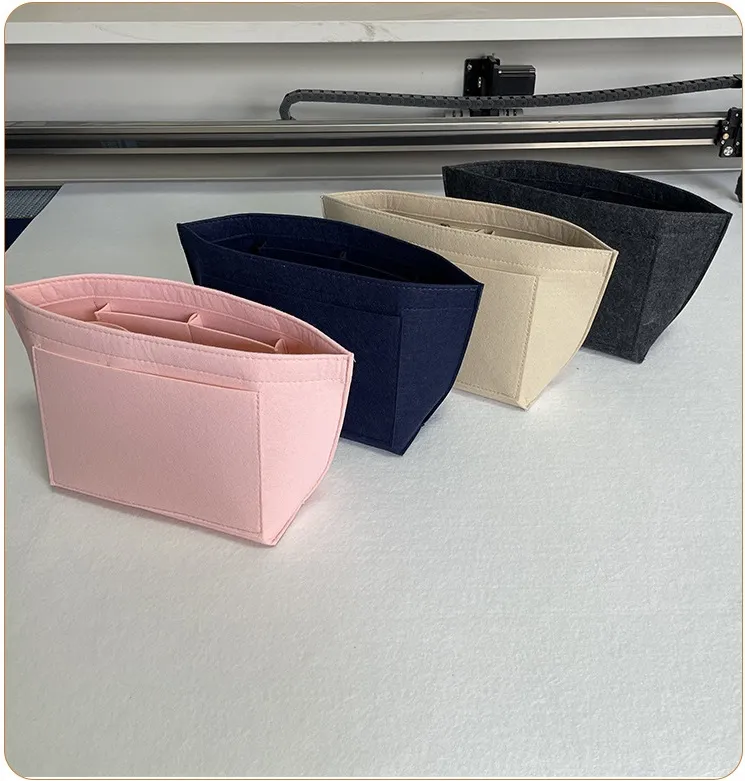
Felt bag organisers represent a specialized segment within the broader landscape of storage solutions, specifically targeting the increasing demand for efficient compartmentalization within handbags and similar carrying cases. These organisers, typically constructed from non-woven textile materials, provide structural support and distinct sections to manage personal items. Their technical position lies between basic bag accessories and more rigid insert systems, offering a balance of flexibility, lightweight properties, and cost-effectiveness. Core performance characteristics encompass dimensional stability, load-bearing capacity, material durability, and compatibility with varying bag interior dimensions. The increasing popularity is driven by the need to mitigate item damage, improve accessibility, and maximize usable space within increasingly compact bag designs. A key pain point addressed is the lack of standardized internal organization in many commercially available bags, leading to disorganised contents and potential damage to sensitive items like electronics or cosmetics. The market demands consistent form factors, robust construction capable of repeated use, and increasingly, sustainable material sourcing.
Material Science & Manufacturing
The primary material utilized in felt bag organisers is typically polyester or polypropylene non-woven fabric. Polyester offers superior tensile strength and abrasion resistance, while polypropylene provides better chemical resistance and lower cost. The choice often depends on the intended application and price point. Raw material properties influencing performance include fiber denier (thickness), basis weight (grams per square meter – gsm), and fiber orientation. Higher gsm values correlate with increased rigidity and durability. Manufacturing typically involves needle-punching or thermo-bonding processes. Needle-punching mechanically interlocks fibers using barbed needles, creating a dense, durable fabric. Thermo-bonding utilizes heat to fuse fibers together, resulting in a smoother surface finish but potentially lower tensile strength. Key parameter control during manufacturing includes consistent fiber distribution, precise needle density (for needle-punched felt), and accurate temperature control (for thermo-bonded felt). Additional materials used often include polypropylene webbing for reinforcement, nylon zippers for closures, and metal or plastic hardware for handles or attachments. The dyeing process employs disperse dyes for polyester and pigment dyes for polypropylene, requiring careful control of dye concentration, temperature, and fixation time to ensure colorfastness and prevent material degradation. Quality control focuses on ensuring consistent fabric thickness, tensile strength meeting minimum specifications (typically exceeding 20 N/cm for structural components), and dimensional accuracy. A significant challenge lies in maintaining material consistency across large production runs due to variations in raw material sourcing and manufacturing processes. Moisture content during processing is also critical, impacting the final product’s dimensional stability.
Performance & Engineering
Performance analysis of felt bag organisers centres around their load-bearing capacity, resistance to deformation, and durability under repeated use. Force analysis involves assessing the tensile stress on seams and structural components when loaded with items. Finite Element Analysis (FEA) can be employed to model stress distribution and identify potential failure points. Environmental resistance is crucial; organisers are exposed to varying temperatures and humidity levels. Prolonged exposure to high humidity can lead to moisture absorption, causing dimensional changes and potential mildew growth. Material degradation due to UV exposure is also a concern, particularly for organisers used in brightly lit environments. Compliance requirements vary depending on the target market. In the EU, REACH regulations restrict the use of certain chemicals in textile products. In the US, CPSIA regulations address lead content and phthalates. Functional implementation requires careful consideration of bag interior dimensions and user needs. Organisers are typically designed with multiple compartments of varying sizes to accommodate different items. Reinforced edges and seams enhance structural integrity and prevent deformation. The selection of closure mechanisms (zippers, snaps, Velcro) impacts usability and security. A key engineering challenge is balancing weight, rigidity, and flexibility to create an organiser that is both supportive and adaptable to different bag shapes and sizes. Furthermore, the design must account for the weight distribution of items within the organiser to prevent uneven stress and potential tearing.
Technical Specifications
| Parameter | Unit | Typical Value (Polyester Felt) | Typical Value (Polypropylene Felt) |
|---|---|---|---|
| Basis Weight | gsm | 400-600 | 200-400 |
| Tensile Strength (Longitudinal) | N/cm | 25-40 | 15-25 |
| Tensile Strength (Transverse) | N/cm | 20-35 | 12-20 |
| Elongation at Break | % | 15-25 | 20-30 |
| Water Absorption | % (24hr) | < 3 | < 2 |
| Dimensional Stability (After Washing) | % Change | +/- 2 | +/- 5 |
Failure Mode & Maintenance
Common failure modes for felt bag organisers include seam separation, fabric tearing, deformation under load, and degradation of closure mechanisms. Seam separation typically occurs due to insufficient stitch density, low-quality thread, or excessive stress. Fabric tearing can result from sharp objects puncturing the material or concentrated stress at weak points. Deformation under load is more prevalent in lower-density felt materials and can lead to loss of structural integrity. Degradation of zippers or snaps is often caused by corrosion or mechanical fatigue. Fatigue cracking occurs due to repeated bending and flexing of the material, particularly along creases. Delamination, while less common, can occur in thermo-bonded felt if the bonding process is inadequate. Oxidation of the fibers, particularly in polypropylene felt exposed to UV light, leads to embrittlement and discoloration. Maintenance involves regular cleaning with a mild detergent and water. Avoid harsh chemicals or abrasive cleaners, as they can damage the fibers. For zipper repairs, lubrication with a silicone-based lubricant can restore functionality. Seam repairs can be performed with a sewing machine using a matching thread. Preventive measures include avoiding overloading the organiser, protecting it from sharp objects, and storing it in a cool, dry place. Periodic inspection of seams and closures can identify potential issues before they escalate into major failures. Proper storage is critical to mitigating long-term degradation.
Industry FAQ
Q: What is the optimal felt density (gsm) for a bag organiser intended to carry heavier items like laptops or tablets?
A: For supporting heavier items, a felt density of 500-600 gsm is recommended. This provides sufficient rigidity and structural support to prevent deformation and protect the devices. Lower gsm values may result in sagging or inadequate protection.
Q: How does the choice between polyester and polypropylene felt impact the organiser's resistance to chemical spills?
A: Polypropylene felt exhibits superior resistance to chemical spills compared to polyester. Polyester is more susceptible to staining and damage from solvents and other chemicals commonly found in cosmetics or toiletries.
Q: What measures can be taken to improve the longevity of the organiser's seams?
A: Utilizing high-quality, abrasion-resistant thread (e.g., nylon or polyester) and increasing the stitch density will significantly improve seam durability. Reinforcing stress points with additional stitching or webbing is also beneficial.
Q: Are there any specific standards or certifications related to the flammability of felt used in bag organisers?
A: While there aren't universally mandated certifications, some manufacturers adhere to standards like FMVSS 302 (Flammability of Interior Materials for Motor Vehicles) or similar regional standards depending on the intended end-use and market. Ensuring the felt meets basic flammability requirements is a best practice.
Q: How does UV exposure affect the performance of polypropylene felt over time, and what mitigation strategies are available?
A: Prolonged UV exposure causes polypropylene felt to become brittle and discolored. Mitigation strategies include using UV-stabilized polypropylene, incorporating UV-protective coatings, and recommending storage in shaded areas when not in use. Regular inspection for signs of degradation is also important.
Conclusion
Felt bag organisers represent a valuable accessory for optimizing space and protecting valuables within handbags. The material science underpinning their construction, particularly the choice between polyester and polypropylene felt, directly impacts performance characteristics such as tensile strength, chemical resistance, and durability. Manufacturing processes, including needle-punching and thermo-bonding, require precise parameter control to ensure consistent quality and structural integrity.
Looking ahead, the industry will likely see increasing demand for sustainable materials and eco-friendly manufacturing processes. Advancements in non-woven fabric technology could lead to the development of felt materials with enhanced performance characteristics, such as improved abrasion resistance and UV protection. Continuous refinement of design and engineering principles will be crucial to addressing the evolving needs of consumers and maintaining a competitive edge in the market.


 English
  Afrikaans
  Albanian
  Amharic
  Arabic
  Armenian
  Azerbaijani
  Basque
  Belarusian
  Bengali
  Bosnian
  Bulgarian
  Catalan
  Cebuano
  Corsican
  Croatian
  Czech
Czech  Danish
  Dutch
Dutch  Esperanto
  Estonian
  Finnish
  French
  Frisian
  Galician
  Georgian
  German
  Greek
Greek  Gujarati
  Haitian Creole
  Hausa
Hausa  Hebrew
  Hindi
Hindi  Miao
Miao  Hungarian
  Icelandic
  Igbo
Igbo  Indonesian
  Irish
Irish  Italian
  Japanese
  Javanese
  Kazakh
  Khmer
Khmer  Rwandese
  Korean
  Kurdish
  Kyrgyz
  Lao
Lao  Latin
Latin  Latvian
  Lithuanian
  Luxembourgish
  Macedonian
  Malgashi
  Malay
Malay  Malayalam
  Maltese
  Maori
Maori  Marathi
  Mongolian
  Myanmar
  Nepali
  Norwegian
  Norwegian
  Occitan
  Pashto
  Persian
  Polish
  Portuguese
  Romanian
  Russian
  Samoan
  Scottish Gaelic
  Serbian
  Sesotho
  Shona
Shona  Sindhi
  Sinhala
  Slovak
  Slovenian
  Somali
  Spanish
  Sundanese
  Swahili
  Swedish
  Tajik
Tajik  Tamil
Tamil  Tatar
Tatar  Telugu
  Thai
Thai  Turkish
  Turkmen
  Ukrainian
  Urdu
Urdu  Uighur
  Uzbek
Uzbek  Vietnamese
  Welsh
Welsh  Bantu
Bantu  Yiddish
  Yoruba
  Zulu
Zulu