
Apr . 01, 2024 17:55 Back to list
felt storage tote Performance Analysis
Introduction
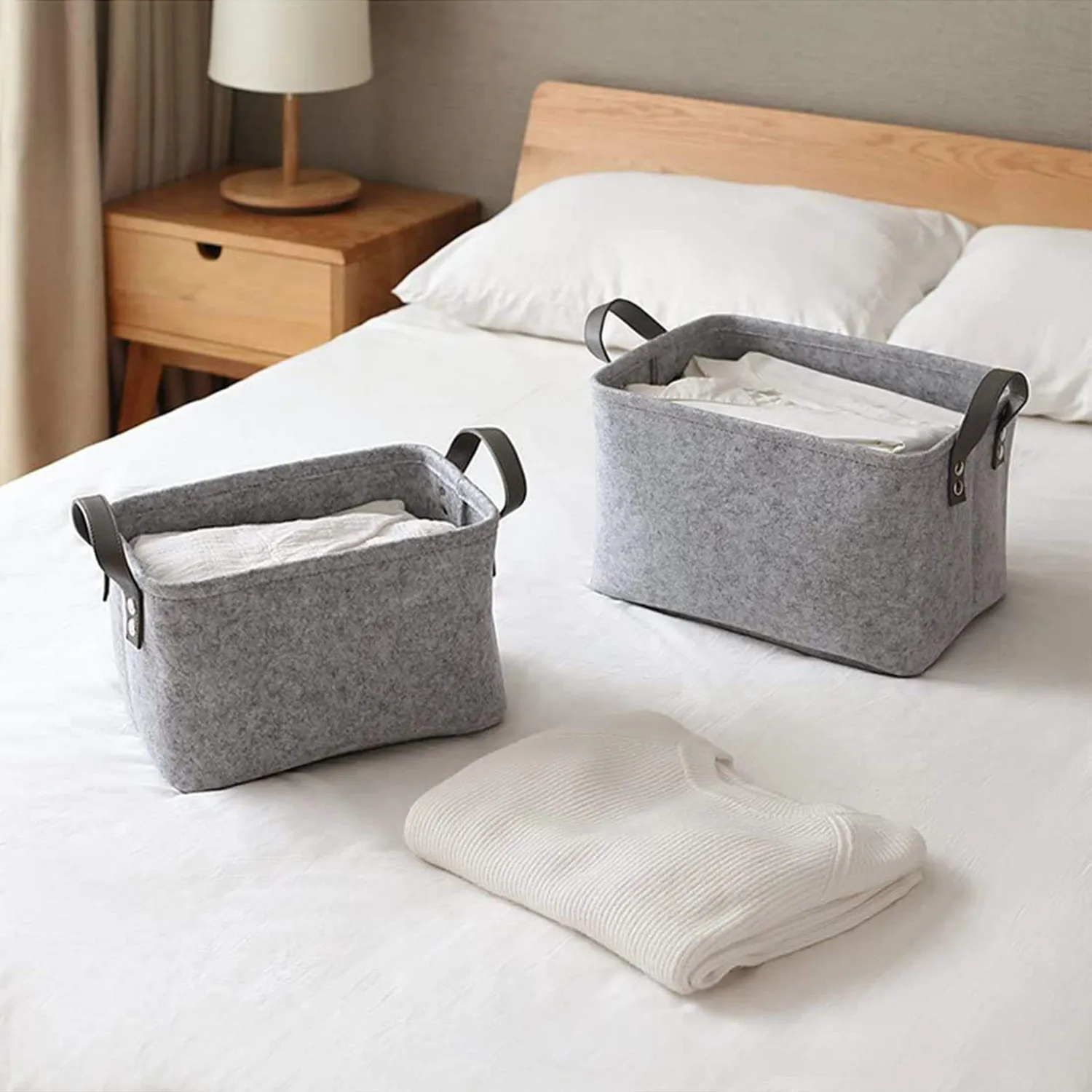
Felt storage totes represent a versatile and cost-effective solution for portable organization across diverse industries, including retail, healthcare, education, and domestic applications. These containers, typically constructed from non-woven polyester fibers treated to mimic the properties of traditional wool felt, offer a lightweight alternative to rigid containers. Their primary function is to provide a flexible, semi-rigid enclosure for the transport and storage of goods, ranging from small components and tools to clothing and personal items. The core performance characteristics influencing their selection revolve around load capacity, durability against abrasion and puncture, environmental resistance, and, increasingly, sustainability considerations related to material sourcing and end-of-life recyclability. The industry faces key pain points concerning consistent material quality, achieving adequate structural integrity for heavier loads, and minimizing environmental impact through the exploration of recycled and biodegradable felt compositions.
Material Science & Manufacturing
The predominant material used in felt storage tote construction is polyester non-woven fabric, often employing needled-punched or thermal-bonding processes. Polyester is favored due to its high tensile strength, resistance to stretching and shrinking, and relatively low cost compared to natural wool felt. Raw material characteristics significantly impact the final product quality; polyester staple fiber length, denier (fineness), and crimp level influence the fabric's bulk, density, and strength. Manufacturing involves several key stages. Fiber preparation includes carding and drafting to align the fibers. The non-woven fabric is created through either needle punching – where barbed needles interlock the fibers – or thermal bonding, utilizing heat to partially melt and fuse the fibers together. Post-fabrication, cutting, sewing, and the application of handles or reinforcements are crucial. Key parameter control focuses on maintaining consistent fabric weight (gsm – grams per square meter), ensuring uniform fiber distribution, and carefully controlling temperature and pressure during thermal bonding to avoid fiber degradation. Color consistency is achieved through precise dye application processes during fiber production. A growing trend involves utilizing recycled PET (polyethylene terephthalate) fibers to reduce reliance on virgin polyester, but this requires careful monitoring for fiber length and contamination levels which can compromise structural integrity. Adhesives used in reinforcing seams must exhibit shear strength compatible with the tote's expected load and environmental conditions.
Performance & Engineering
The structural performance of a felt storage tote is primarily governed by the tensile strength and tear resistance of the polyester fabric. Force analysis focuses on the distribution of load across the tote’s body and handles. Handle attachment points are critical stress concentrators and require robust reinforcement, typically through bar tack stitching or the application of reinforcing patches. Environmental resistance is a significant consideration. While polyester exhibits good resistance to many common chemicals, prolonged exposure to strong acids or bases can cause degradation. UV exposure can lead to fiber embrittlement and discoloration over time, impacting long-term durability. Moisture absorption is relatively low, but prolonged exposure to high humidity can affect dimensional stability. Compliance requirements vary depending on the intended application. For example, totes used in healthcare settings must adhere to standards for cleanability and antimicrobial properties. Those intended for food contact must meet regulations regarding material safety. Engineering considerations include optimizing the tote’s geometry to maximize volume while maintaining structural integrity. Reinforced edges and a reinforced bottom are crucial for preventing deformation under load. The design should also facilitate efficient nesting for space-saving storage when empty.
Technical Specifications
| Parameter | Unit | Typical Value | Test Method |
|---|---|---|---|
| Fabric Weight (gsm) | g/m² | 400-800 | ISO 307 |
| Tensile Strength (Warp) | N/5cm | 150-300 | ISO 527-1 |
| Tensile Strength (Weft) | N/5cm | 150-300 | ISO 527-1 |
| Tear Resistance (Warp) | N | 50-150 | ISO 536-1 |
| Tear Resistance (Weft) | N | 50-150 | ISO 536-1 |
| Water Repellency (Hydrostatic Head) | mm H₂O | 100-300 | ISO 811 |
Failure Mode & Maintenance
Common failure modes for felt storage totes include seam failure due to thread breakage or pull-out, fabric tearing under excessive load, and abrasion leading to material thinning and eventual puncture. Fatigue cracking can occur at handle attachment points with repeated stress cycles. Delamination, while less common in needle-punched felt, can occur in thermally bonded materials if bonding is insufficient. Environmental degradation, specifically UV exposure, leads to fiber embrittlement and reduced tensile strength. Oxidation can also affect polyester fibers over extended periods, particularly in humid environments. Maintenance primarily focuses on preventative measures. Avoiding overloading the tote is crucial. Regular inspection of seams and handle attachments for signs of wear is recommended. Cleaning should be performed with mild soap and water; harsh chemicals can damage the fibers. Storage in a dry, well-ventilated area minimizes the risk of mildew and degradation. Repair options are limited; minor seam repairs can be attempted with appropriate stitching, but significant fabric damage typically necessitates replacement. For prolonged storage, totes should be emptied and flattened to reduce stress on the materials.
Industry FAQ
Q: What is the typical load capacity for a standard felt storage tote, and how is this determined?
A: The typical load capacity ranges from 5kg to 20kg, depending on the fabric weight (gsm), tote dimensions, and handle reinforcement. This is determined through tensile testing of the fabric and load-bearing tests performed on finished totes, simulating real-world usage conditions. Safety factors are incorporated to account for dynamic loads and potential variations in material properties.
Q: How does the use of recycled PET fiber impact the durability and performance of the tote?
A: Recycled PET fiber generally exhibits slightly lower tensile strength and tear resistance compared to virgin polyester, particularly if the recycling process involves significant degradation of the polymer chains. However, advancements in recycling technologies are minimizing this difference. Careful quality control of the recycled fiber, focusing on fiber length and consistency, is essential to maintain acceptable performance levels.
Q: What are the implications of UV exposure on the lifespan of a felt storage tote?
A: Prolonged UV exposure causes photo-oxidation of the polyester fibers, leading to embrittlement, reduced tensile strength, and discoloration. The rate of degradation depends on the intensity of UV radiation and the duration of exposure. UV stabilizers can be incorporated into the polyester fibers to mitigate this effect, extending the tote's lifespan.
Q: Are felt storage totes suitable for storing items with sharp edges, and what measures can be taken to improve puncture resistance?
A: Felt storage totes offer limited puncture resistance. Items with sharp edges can easily penetrate the fabric. To improve puncture resistance, a thicker fabric weight (gsm) should be used, and the tote can be lined with a more robust material such as polypropylene or a reinforced polymer film.
Q: What are the sustainability considerations associated with felt storage totes, and are there biodegradable alternatives?
A: The primary sustainability concern is the reliance on polyester, a petroleum-based product. Utilizing recycled PET fiber reduces this dependence. Biodegradable alternatives, such as those made from plant-based fibers (e.g., cotton, hemp), are available but often exhibit lower durability and higher cost. End-of-life recyclability is also a crucial consideration; polyester can be recycled, but effective collection and sorting infrastructure are essential.
Conclusion
Felt storage totes represent a pragmatic solution for portable organization, balancing cost-effectiveness with reasonable durability. Their performance is fundamentally tied to the properties of the polyester fabric—specifically, its tensile strength, tear resistance, and resistance to environmental factors. Careful material selection, controlled manufacturing processes, and a clear understanding of potential failure modes are paramount to ensuring a reliable and long-lasting product.
Looking ahead, advancements in material science will likely focus on enhancing the sustainability of these totes, with increased adoption of recycled and biodegradable materials. Continued research into UV stabilization techniques and puncture resistance enhancement will also be crucial for expanding their applicability across diverse industries. The industry must prioritize standardization of testing methods to accurately assess and compare the performance characteristics of different tote designs and materials.


 English
  Afrikaans
  Albanian
  Amharic
  Arabic
  Armenian
  Azerbaijani
  Basque
  Belarusian
  Bengali
  Bosnian
  Bulgarian
  Catalan
  Cebuano
  Corsican
  Croatian
  Czech
Czech  Danish
  Dutch
Dutch  Esperanto
  Estonian
  Finnish
  French
  Frisian
  Galician
  Georgian
  German
  Greek
Greek  Gujarati
  Haitian Creole
  Hausa
Hausa  Hebrew
  Hindi
Hindi  Miao
Miao  Hungarian
  Icelandic
  Igbo
Igbo  Indonesian
  Irish
Irish  Italian
  Japanese
  Javanese
  Kazakh
  Khmer
Khmer  Rwandese
  Korean
  Kurdish
  Kyrgyz
  Lao
Lao  Latin
Latin  Latvian
  Lithuanian
  Luxembourgish
  Macedonian
  Malgashi
  Malay
Malay  Malayalam
  Maltese
  Maori
Maori  Marathi
  Mongolian
  Myanmar
  Nepali
  Norwegian
  Norwegian
  Occitan
  Pashto
  Persian
  Polish
  Portuguese
  Romanian
  Russian
  Samoan
  Scottish Gaelic
  Serbian
  Sesotho
  Shona
Shona  Sindhi
  Sinhala
  Slovak
  Slovenian
  Somali
  Spanish
  Sundanese
  Swahili
  Swedish
  Tajik
Tajik  Tamil
Tamil  Tatar
Tatar  Telugu
  Thai
Thai  Turkish
  Turkmen
  Ukrainian
  Urdu
Urdu  Uighur
  Uzbek
Uzbek  Vietnamese
  Welsh
Welsh  Bantu
Bantu  Yiddish
  Yoruba
  Zulu
Zulu