
Apr . 01, 2024 17:55 Back to list
bottle green felt Performance Analysis
Introduction
Bottle green felt is a non-woven textile material produced by matting, condensing and bonding fibers. Specifically, bottle green felt refers to felt produced utilizing fibers dyed a shade of green resembling dark glass bottles. Its position within the textile industry chain is as a value-added product derived from base fiber production (wool, synthetic fibers, or blends), undergoing processing into a usable semi-finished or finished component. Core performance characteristics center around its cushioning, insulation (thermal and acoustic), filtration, and protective qualities. Its application spans diverse sectors including automotive interiors, industrial padding, crafting, and soundproofing. Unlike woven fabrics, felt’s isotropic nature (properties are the same in all directions) contributes to its unique performance profile. A key industry pain point is achieving consistent color matching and minimizing batch-to-batch variation in physical properties, particularly density and thickness, impacting downstream manufacturing processes.
Material Science & Manufacturing
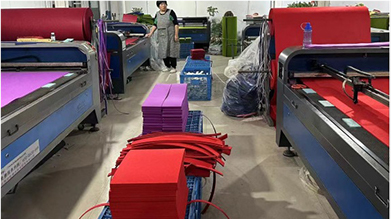
The composition of bottle green felt dictates its properties. Common fiber materials include wool (renowned for its natural crimp and resilience), acrylic (offering good bulk and cost-effectiveness), polyester (known for its durability and resistance to stretching/shrinking), polypropylene (providing high strength-to-weight ratio and chemical resistance), and rayon/viscose (derived from cellulose, offering a silk-like drape). The bottle green coloration stems from the application of dyes – typically acid dyes for wool and acrylic, and disperse dyes for polyester. The dyeing process itself is critical; ensuring uniform dye penetration and colorfastness (resistance to fading from light, washing, and abrasion) is paramount. Manufacturing typically follows these stages: Fiber preparation (cleaning, carding), web formation (laying out fibers in a sheet), bonding (achieving cohesion between fibers), and finishing (density control, cutting, and surface treatment). Bonding methods include mechanical entanglement (needle punching – using barbed needles to interlock fibers), thermal bonding (melting fibers at contact points), and chemical bonding (using adhesives). Needle punching is prevalent for thicker felts requiring high strength. Thermal bonding is used for finer felts, while adhesive bonding finds niche applications where specific chemical resistance is required. Critical parameters include needle density (needles per square inch), punching speed, oven temperature (for thermal bonding), adhesive viscosity, and fiber denier (fineness). Controlling these ensures desired density, thickness, and strength properties. The industry faces challenges in transitioning to more sustainable fiber sources and reducing the environmental impact of dyeing processes.
Performance & Engineering
The performance of bottle green felt is largely dictated by its density, thickness, and fiber composition. Force analysis reveals that felt's compressive strength is directly proportional to its density. Higher density felts provide greater cushioning and protection. Tensile strength, however, is generally lower than woven fabrics due to the lack of a structured weave. Environmental resistance is a crucial consideration. Exposure to UV radiation can cause degradation of fibers, particularly acrylics and polypropylenes, leading to color fading and reduced strength. Moisture absorption varies considerably based on fiber type; wool exhibits high moisture absorbency while polypropylene is hydrophobic. This influences applications – wool is favored for applications requiring moisture wicking, whereas polypropylene is preferred for outdoor applications. Compliance requirements depend on the intended use. Automotive applications necessitate adherence to flammability standards (FMVSS 302 in the US), while medical applications require biocompatibility testing (ISO 10993 series). For soundproofing applications, the Noise Reduction Coefficient (NRC) is a key metric – higher NRC values indicate better sound absorption. The felt’s porosity (air permeability) plays a significant role in NRC. Engineering considerations include the need to tailor felt properties to specific application requirements. This may involve blending different fiber types, applying surface treatments (e.g., water repellents, flame retardants), or laminating the felt to other materials for enhanced performance. A primary industry challenge is balancing performance requirements with cost considerations.
Technical Specifications
| Property | Wool Felt (Bottle Green) | Polyester Felt (Bottle Green) | Acrylic Felt (Bottle Green) | Polypropylene Felt (Bottle Green) |
|---|---|---|---|---|
| Density (g/m²) | 500-800 | 300-600 | 400-700 | 200-500 |
| Thickness (mm) | 3-10 | 1-5 | 2-8 | 1-4 |
| Tensile Strength (N/50mm) | 150-300 | 80-150 | 100-200 | 120-250 |
| Elongation at Break (%) | 30-60 | 50-100 | 40-80 | 80-150 |
| Water Absorption (%) | 20-30 | 0.5-1.5 | 2-5 | <0.5 |
| NRC (Noise Reduction Coefficient) | 0.5-0.8 | 0.3-0.6 | 0.4-0.7 | 0.2-0.5 |
Failure Mode & Maintenance
Bottle green felt is susceptible to several failure modes. Mechanical degradation includes tearing, abrasion, and compression set (permanent deformation under load). Abrasion is particularly relevant in applications involving repeated contact or rubbing. Fatigue cracking can occur under cyclic loading, especially in thinner felts. Chemical degradation can result from exposure to harsh chemicals, solvents, or acids, leading to fiber dissolution or weakening. UV degradation, as mentioned previously, causes color fading and embrittlement. Biological degradation (mold and mildew growth) can occur in humid environments, particularly with wool felt. Delamination (separation of layers in laminated felts) is a common failure mode. To mitigate these, preventative maintenance is crucial. Regular cleaning (vacuuming or gentle brushing) removes dust and debris that can accelerate abrasion. Avoiding exposure to direct sunlight and harsh chemicals extends service life. For wool felt, mothproofing treatments are recommended. Storage should be in a dry, well-ventilated area. When damage occurs, localized repair using appropriate adhesives or patching techniques can extend the functional life of the felt. Complete replacement may be necessary in cases of severe degradation or delamination. Careful selection of fiber type based on the anticipated operating environment is the most effective preventative measure.
Industry FAQ
Q: What is the impact of fiber blend ratios on the overall performance of bottle green felt for automotive headliners?
A: Fiber blend ratios significantly impact performance. Increasing wool content enhances acoustic absorption and tactile feel but increases cost and susceptibility to moisture. Polyester improves durability and reduces cost but lowers acoustic performance. A common blend is 70% wool/30% polyester, balancing performance and cost. The specific ratio is determined by the vehicle’s acoustic requirements and budget constraints. Careful consideration must be given to the impact of blending on flammability characteristics and compliance with FMVSS 302.
Q: How does the needle punching process affect the dimensional stability of the felt?
A: The needle punching process, while creating fiber interlocking, can introduce dimensional instability. Excessive punching can cause fiber breakage and shrinkage, leading to reduced thickness and altered dimensions. Careful control of needle density, punching speed, and machine settings is crucial. Post-processing heat setting can help stabilize the dimensions by relaxing stresses induced during punching.
Q: What are the advantages and disadvantages of using different dyes to achieve the bottle green coloration?
A: Acid dyes (for wool/acrylic) offer vibrant color and good wash fastness but can have environmental concerns related to dye effluent. Disperse dyes (for polyester) are more environmentally friendly but may exhibit lower color brilliance. Reactive dyes can also be used, providing excellent wash fastness. The choice depends on fiber type, performance requirements, and environmental regulations. Color matching across batches is a persistent challenge.
Q: Can bottle green felt be recycled, and what are the challenges associated with its recycling?
A: Recycling bottle green felt is challenging due to the mixed fiber compositions and the bonding agents used. Mechanical recycling (shredding and re-bonding) is possible, but the resulting felt typically has reduced strength and altered properties. Chemical recycling (breaking down fibers to their constituent monomers) is still under development and not economically viable for large-scale production. The presence of dyes and additives further complicates the recycling process.
Q: What testing methods are used to assess the flammability of bottle green felt intended for public seating?
A: For public seating, flammability is critical. Standard tests include the California Technical Bulletin 117 (TB 117), which assesses smolder resistance, and FMVSS 302 (for automotive applications). These tests involve exposing the felt to a flame source and measuring ignition time, flame spread rate, and heat release. Flame retardant treatments can be applied to enhance fire resistance, but these treatments can also affect other properties and may raise environmental concerns.
Conclusion
Bottle green felt is a versatile material with a broad range of applications, but its performance is heavily dependent on fiber selection, manufacturing processes, and environmental factors. Maintaining consistent quality control throughout the production chain – from fiber sourcing to dyeing and bonding – is essential to meet demanding industry requirements. The ongoing drive for sustainability presents a significant challenge and opportunity for innovation in both fiber materials and manufacturing techniques.
Future development will likely focus on utilizing bio-based and recycled fibers, optimizing dyeing processes to minimize environmental impact, and developing more effective and environmentally friendly bonding agents. Continued research into enhancing the durability and resistance to degradation of bottle green felt will broaden its application scope and address the core pain points identified by industry professionals.


 English
  Afrikaans
  Albanian
  Amharic
  Arabic
  Armenian
  Azerbaijani
  Basque
  Belarusian
  Bengali
  Bosnian
  Bulgarian
  Catalan
  Cebuano
  Corsican
  Croatian
  Czech
Czech  Danish
  Dutch
Dutch  Esperanto
  Estonian
  Finnish
  French
  Frisian
  Galician
  Georgian
  German
  Greek
Greek  Gujarati
  Haitian Creole
  Hausa
Hausa  Hebrew
  Hindi
Hindi  Miao
Miao  Hungarian
  Icelandic
  Igbo
Igbo  Indonesian
  Irish
Irish  Italian
  Japanese
  Javanese
  Kazakh
  Khmer
Khmer  Rwandese
  Korean
  Kurdish
  Kyrgyz
  Lao
Lao  Latin
Latin  Latvian
  Lithuanian
  Luxembourgish
  Macedonian
  Malgashi
  Malay
Malay  Malayalam
  Maltese
  Maori
Maori  Marathi
  Mongolian
  Myanmar
  Nepali
  Norwegian
  Norwegian
  Occitan
  Pashto
  Persian
  Polish
  Portuguese
  Romanian
  Russian
  Samoan
  Scottish Gaelic
  Serbian
  Sesotho
  Shona
Shona  Sindhi
  Sinhala
  Slovak
  Slovenian
  Somali
  Spanish
  Sundanese
  Swahili
  Swedish
  Tajik
Tajik  Tamil
Tamil  Tatar
Tatar  Telugu
  Thai
Thai  Turkish
  Turkmen
  Ukrainian
  Urdu
Urdu  Uighur
  Uzbek
Uzbek  Vietnamese
  Welsh
Welsh  Bantu
Bantu  Yiddish
  Yoruba
  Zulu
Zulu