Apr . 01, 2024 17:55 Back to list
lilac felt Performance Analysis

Introduction
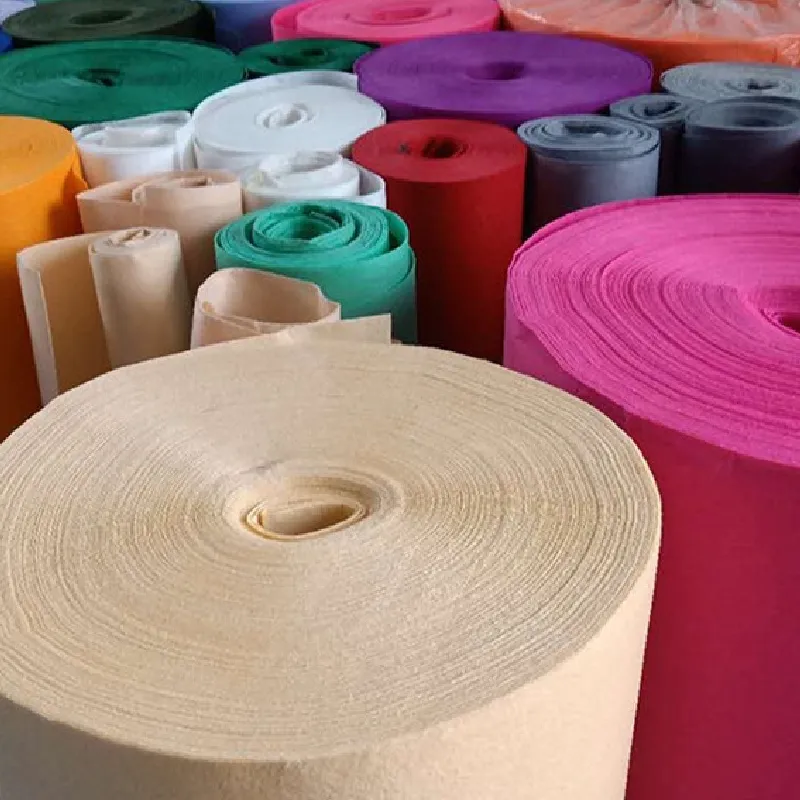
Lilac felt is a non-woven textile material constructed from compressed fibers, typically composed of wool, acrylic, polyester, or blends thereof, and dyed to a shade of lilac. Its position within the industrial chain spans several sectors, including filtration, insulation, crafts, protective padding, and increasingly, specialized industrial applications demanding controlled density and conformability. Core performance characteristics include thermal and acoustic insulation, cushioning, liquid absorption, and dimensional stability. However, lilac felt's performance is highly dependent on the fiber composition, manufacturing process, and post-treatment applied, posing significant challenges to consistent quality control and application suitability. The textile industry often struggles with variability in felt density, thickness, and color fastness, affecting its usability in critical applications. Understanding the nuanced relationship between manufacturing parameters and final product performance is paramount for successful implementation.
Material Science & Manufacturing
The primary raw materials for lilac felt—wool, acrylic, polyester, and polypropylene—possess distinct physical and chemical properties. Wool, a natural protein fiber, exhibits excellent crimp, elasticity, and inherent flame resistance, but is susceptible to biodegradation and shrinkage. Acrylic fibers offer good bulk, warmth, and resistance to sunlight and chemicals, but have lower abrasion resistance than wool. Polyester provides high tensile strength, dimensional stability, and resistance to stretching and shrinking, while polypropylene is lightweight, hydrophobic, and cost-effective, but has a lower melting point. The choice of fiber significantly influences the felt’s properties.
Manufacturing typically involves carding, where fibers are aligned, followed by needling (mechanical interlocking), chemical bonding (using resins), or a combination of both. Needling creates a mechanically interlocked structure, offering good strength and durability but potential for fiber migration. Chemical bonding provides a more uniform structure, but can reduce breathability and impact long-term flexibility. Critical process parameters include carding speed, needle density and penetration depth, resin concentration and curing temperature, and calendering pressure. Control of these parameters is crucial to achieving desired density, thickness, and uniformity. Coloration is typically achieved through dye addition during the fiber preparation stage or post-formation dyeing. Precise control of dye concentration, temperature, and processing time is vital for consistent lilac hue and colorfastness. Fiber length, fineness, and crimp also play a significant role; shorter fibers generally lead to a denser, more compact felt, while finer fibers create a smoother surface finish.
Performance & Engineering
The performance of lilac felt in engineering applications is dictated by its structural integrity and response to external forces. Force analysis reveals that the felt’s ability to withstand compression and shear stress depends on fiber interlock density and the inherent strength of the constituent fibers. The Poisson's ratio (the ratio of transverse strain to axial strain) is an important parameter, indicating the material’s tendency to expand or contract in directions perpendicular to the applied force. Environmental resistance, particularly moisture absorption and UV degradation, is a critical consideration. Wool-based felts are prone to swelling in humid environments, while acrylic and polyester felts exhibit better resistance. UV radiation can cause fiber breakdown and discoloration, particularly in acrylic felts. Compliance requirements vary by industry. For example, applications in cleanroom environments necessitate low particle shedding, while automotive applications require resistance to temperature extremes and automotive fluids. Functional implementation often involves lamination with other materials, such as adhesives, foams, or fabrics, to enhance specific properties like water resistance or abrasion resistance. The selection of appropriate adhesives is crucial to ensure long-term bond integrity and prevent delamination. The felt's permeability, crucial for filtration applications, is determined by fiber density and pore size distribution.
Technical Specifications
| Parameter | Wool Felt (Typical) | Acrylic Felt (Typical) | Polyester Felt (Typical) | Polypropylene Felt (Typical) |
|---|---|---|---|---|
| Density (g/cm³) | 0.2 – 0.5 | 0.15 – 0.35 | 0.25 – 0.6 | 0.08 – 0.2 |
| Thickness (mm) | 1 – 10 | 0.5 – 5 | 1 – 8 | 0.5 – 4 |
| Tensile Strength (MPa) | 0.5 – 2.0 | 0.8 – 3.0 | 1.0 – 4.0 | 0.6 – 2.5 |
| Elongation at Break (%) | 10 – 30 | 20 – 50 | 30 – 70 | 100 – 200 |
| Water Absorption (%) | 30 – 50 | 5 – 15 | 2 – 8 | <1 |
| Thermal Conductivity (W/m·K) | 0.03 – 0.05 | 0.035 – 0.06 | 0.03 – 0.045 | 0.03 – 0.04 |
Failure Mode & Maintenance
Lilac felt, like all textiles, is susceptible to several failure modes. Fatigue cracking can occur under repeated stress, particularly in applications involving cyclic loading. This is often initiated by microscopic flaws or fiber breakage. Delamination, the separation of layers within the felt, can result from inadequate bonding or exposure to solvents. Degradation of the fibers themselves is a common issue, caused by UV exposure, oxidation, or chemical attack. Wool is prone to moth damage and biodegradation. Acrylic fibers can yellow or become brittle with prolonged UV exposure. Polyester and polypropylene are generally more resistant to chemical attack, but can degrade at elevated temperatures. Oxidation, particularly in the presence of moisture and oxygen, can lead to fiber embrittlement and discoloration.
Maintenance strategies depend on the application and fiber composition. Regular cleaning with mild detergents is crucial to remove dirt and debris. Avoid harsh chemicals or abrasive cleaners. For wool felts, mothproofing treatments are recommended. UV protection sprays can help extend the lifespan of acrylic and polyester felts. Store felt in a cool, dry place away from direct sunlight. Inspect regularly for signs of wear, damage, or delamination. Minor repairs, such as patching or re-bonding, can extend the service life, but significant damage often necessitates replacement. Proper handling and storage are critical to preventing premature failure.
Industry FAQ
Q: What is the impact of different needle densities during the needling process on the final felt properties?
A: Higher needle densities generally result in a denser, more compact felt with increased tensile strength and reduced porosity. However, excessively high needle density can lead to fiber breakage and reduced flexibility. The optimal needle density is a balance between these factors, dependent on the desired application and fiber type.
Q: How does the choice of dye affect the colorfastness and long-term stability of the lilac color?
A: The type of dye used significantly impacts colorfastness. Reactive dyes generally offer the best colorfastness to washing and light, but can be more expensive. Direct dyes are less expensive but prone to fading. Pigment dyes offer good lightfastness but can affect the felt’s hand feel. The quality of the dye and the dyeing process are critical for achieving consistent color and preventing fading over time.
Q: What are the key considerations when selecting lilac felt for filtration applications?
A: For filtration, pore size, permeability, and chemical resistance are paramount. Fiber density and diameter control pore size. Chemical resistance must match the fluid being filtered. Wool felt is generally unsuitable for aggressive chemical environments, whereas polyester and polypropylene offer better resistance. Particle retention efficiency is also a critical parameter.
Q: Can lilac felt be recycled, and what are the limitations of recycling processes?
A: Recycling lilac felt is challenging due to the mixed fiber composition and potential contamination. Mechanical recycling (shredding and re-needling) can be employed, but often results in reduced fiber length and lower quality felt. Chemical recycling, breaking down the fibers into their constituent monomers, is more complex and expensive. The presence of dyes and finishes can also hinder recycling efforts.
Q: What methods can be used to improve the dimensional stability of lilac felt, particularly in high-humidity environments?
A: Dimensional stability can be improved through several methods. Using synthetic fibers (polyester or polypropylene) instead of wool reduces moisture absorption. Applying a water-repellent finish can also mitigate swelling. Heat setting or calendering can compress the felt structure and reduce its tendency to expand. Laminating the felt to a stable backing material can provide additional support.
Conclusion
Lilac felt represents a versatile material with applications spanning diverse industries. However, its performance is intricately linked to the raw material selection, manufacturing process control, and the specific requirements of the end application. Understanding the interplay between fiber properties, process parameters, and environmental factors is essential for ensuring consistent quality and achieving optimal performance. The inherent variability of natural fibers like wool necessitates careful consideration, often favoring synthetic alternatives for applications demanding precise dimensional stability or chemical resistance.
Future developments in lilac felt technology will likely focus on enhancing sustainability through improved recycling processes and the development of bio-based fiber alternatives. Advancements in non-woven manufacturing techniques, such as ultrasonic bonding, may offer more precise control over felt properties and reduce reliance on chemical binders. Further research into novel fiber treatments and finishes will be crucial for improving durability, enhancing performance characteristics, and broadening the scope of applications for this adaptable textile material.


 English
  Afrikaans
  Albanian
  Amharic
  Arabic
  Armenian
  Azerbaijani
  Basque
  Belarusian
  Bengali
  Bosnian
  Bulgarian
  Catalan
  Cebuano
  Corsican
  Croatian
  Czech
Czech  Danish
  Dutch
Dutch  Esperanto
  Estonian
  Finnish
  French
  Frisian
  Galician
  Georgian
  German
  Greek
Greek  Gujarati
  Haitian Creole
  Hausa
Hausa  Hebrew
  Hindi
Hindi  Miao
Miao  Hungarian
  Icelandic
  Igbo
Igbo  Indonesian
  Irish
Irish  Italian
  Japanese
  Javanese
  Kazakh
  Khmer
Khmer  Rwandese
  Korean
  Kurdish
  Kyrgyz
  Lao
Lao  Latin
Latin  Latvian
  Lithuanian
  Luxembourgish
  Macedonian
  Malgashi
  Malay
Malay  Malayalam
  Maltese
  Maori
Maori  Marathi
  Mongolian
  Myanmar
  Nepali
  Norwegian
  Norwegian
  Occitan
  Pashto
  Persian
  Polish
  Portuguese
  Romanian
  Russian
  Samoan
  Scottish Gaelic
  Serbian
  Sesotho
  Shona
Shona  Sindhi
  Sinhala
  Slovak
  Slovenian
  Somali
  Spanish
  Sundanese
  Swahili
  Swedish
  Tajik
Tajik  Tamil
Tamil  Tatar
Tatar  Telugu
  Thai
Thai  Turkish
  Turkmen
  Ukrainian
  Urdu
Urdu  Uighur
  Uzbek
Uzbek  Vietnamese
  Welsh
Welsh  Bantu
Bantu  Yiddish
  Yoruba
  Zulu
Zulu