Apr . 01, 2024 17:55 Back to list
Neon Yellow Felt Performance Analysis
Introduction
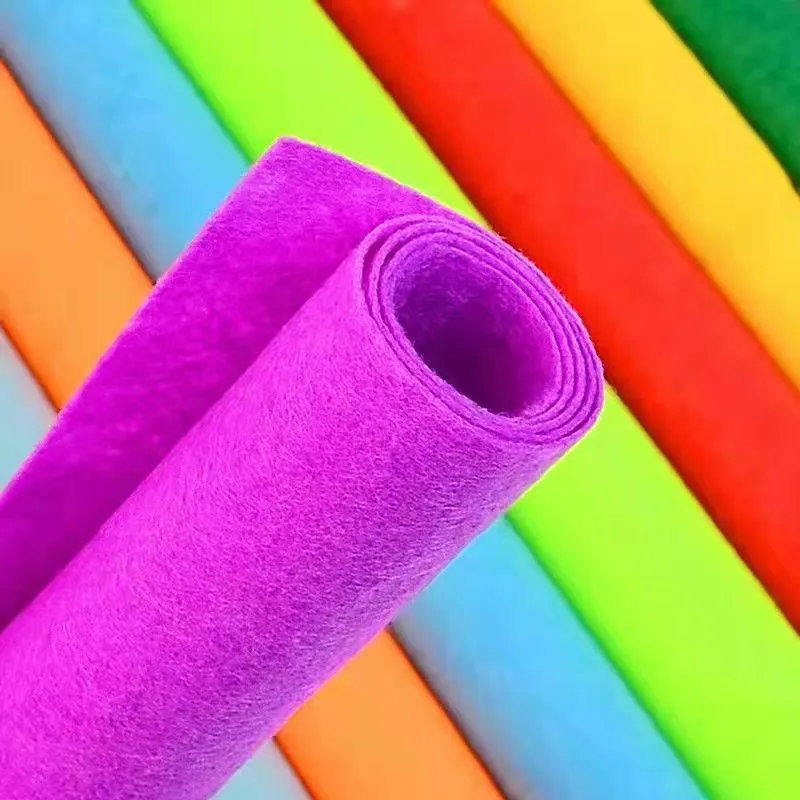
Neon yellow felt is a non-woven textile material constructed from compressed and matted fibers, predominantly synthetic polymers such as polyester, acrylic, or polypropylene, colored with vibrant neon yellow dyes. Its position within the textile industry chain is as a versatile intermediary product, often serving as a base material for crafts, industrial applications, and protective padding. Core performance characteristics of neon yellow felt are defined by its density, thickness, tensile strength, colorfastness, and thermal insulation properties. While aesthetically prominent due to its high visibility, its functional utility hinges on its ability to be easily cut, molded, and bonded, making it suitable for a wide array of applications ranging from hobbyist projects to specialized engineering components. A key industry pain point is maintaining consistent color vibrancy across production batches and ensuring the felt meets flammability standards for specific applications. Furthermore, its relatively low tensile strength compared to woven fabrics limits its use in load-bearing applications, necessitating careful consideration of its structural limitations.
Material Science & Manufacturing
The primary raw materials for neon yellow felt are synthetic polymer fibers – predominantly polyester (PET), polypropylene (PP), and acrylic. Polyester provides good resilience and dimensional stability, polypropylene offers excellent chemical resistance and lower cost, and acrylic fibers contribute to a softer hand and improved dye uptake. The neon yellow coloration is achieved through the incorporation of fluorescent dyes, typically azo dyes or styryl dyes, during the fiber manufacturing process. These dyes absorb ultraviolet (UV) light and re-emit it as visible neon yellow light, creating the high-visibility effect. The manufacturing process begins with fiber production, followed by web formation. Fibers are laid out in a uniform layer, often through carding, a mechanical process that disentangles and aligns the fibers. This web is then subjected to needle punching, a mechanical bonding technique where barbed needles repeatedly penetrate the web, interlocking the fibers. This process creates the felt structure without the need for adhesives or weaving. Alternatively, thermal bonding, using heat and pressure to melt and fuse the fibers, can also be employed. Key parameters in manufacturing include fiber denier (fineness), web density (mass per unit area), needle density (needles per square inch), and the temperature and pressure applied during bonding. Maintaining consistent parameters is crucial for achieving uniform thickness, density, and mechanical properties. Variation in these parameters impacts the final product’s performance, leading to inconsistencies in color, strength, and durability.
Performance & Engineering
The performance of neon yellow felt is largely dictated by its physical and mechanical properties. Tensile strength, measured in pounds per square inch (PSI) or Newtons per square meter (N/m²), determines its resistance to tearing and deformation under stress. Elongation at break, expressed as a percentage, indicates the extent to which the felt can stretch before fracturing. Density, measured in grams per cubic centimeter (g/cm³), influences its weight and thermal insulation properties. Dimensional stability, assessed through shrinkage tests after exposure to heat and humidity, is crucial for applications requiring precise dimensions. Environmental resistance is also a key consideration. Prolonged exposure to UV radiation can cause color fading and degradation of the polymer fibers. Chemical resistance varies depending on the fiber type; polyester and polypropylene generally exhibit good resistance to acids and alkalis, while acrylic fibers are more susceptible to solvent attack. From an engineering perspective, force analysis is essential for applications involving impact absorption or cushioning. The felt’s compression set, the permanent deformation after being subjected to compressive stress, dictates its ability to recover its original shape. Compliance requirements depend on the intended application. For example, in children’s products, the felt must comply with EN 71-3 regarding heavy metal content and migration. In automotive applications, it must meet flammability standards such as FMVSS 302. Furthermore, the neon yellow color itself presents engineering considerations. The intensity and consistency of the color are crucial for high-visibility applications, and must be evaluated using spectrophotometric measurements.
Technical Specifications
| Property | Polyester Felt (Typical) | Polypropylene Felt (Typical) | Acrylic Felt (Typical) | Units |
|---|---|---|---|---|
| Density | 0.5 - 0.8 | 0.4 - 0.6 | 0.3 - 0.5 | g/cm³ |
| Tensile Strength | 50 - 120 | 30 - 80 | 40 - 100 | PSI |
| Elongation at Break | 150 - 300 | 200 - 400 | 100 - 250 | % |
| Thickness | 1 - 5 | 0.5 - 3 | 1 - 4 | mm |
| Colorfastness to Light (Grey Scale) | 4 - 6 | 3 - 5 | 5 - 7 | (1-8, 8 is best) |
| Flammability (LOI) | 22 - 24 | 24 - 26 | 20 - 22 | % Oxygen Index |
Failure Mode & Maintenance
Neon yellow felt, while versatile, is susceptible to several failure modes. The most common is fiber degradation due to prolonged UV exposure, leading to color fading and a reduction in tensile strength. This degradation is exacerbated by exposure to high temperatures and humidity. Another failure mode is delamination, the separation of the felt layers, particularly in needle-punched felts where the interlocking fibers can become dislodged under stress. Mechanical wear and tear, such as abrasion and tearing, can also lead to failure, especially in applications involving repeated friction or impact. Oxidation, particularly in acrylic felts, can cause brittleness and cracking. Finally, chemical attack from solvents or corrosive substances can dissolve or weaken the polymer fibers. Maintenance to mitigate these failures involves minimizing UV exposure by storing the felt in a dark, dry place. Regular inspection for signs of wear and tear, such as fraying or thinning, is crucial. Gentle cleaning with mild detergent and water can remove dirt and debris without damaging the fibers. Avoid harsh chemicals or abrasive cleaners. For applications requiring high durability, consider applying a protective coating, such as a UV-resistant sealant or a water-repellent finish. In cases of significant delamination or damage, replacement of the felt is typically recommended.
Industry FAQ
Q: What is the impact of different dye types on the long-term colorfastness of neon yellow felt?
A: The type of dye significantly affects colorfastness. Azo dyes, while cost-effective, are more prone to fading with UV exposure compared to styryl dyes. Styryl dyes offer superior lightfastness but are generally more expensive. The dye concentration and the fiber’s ability to absorb and retain the dye also play a crucial role. Selecting a dye specifically formulated for the fiber type and ensuring proper dye fixation during manufacturing are essential for maximizing color retention.
Q: How does the choice of fiber (polyester, polypropylene, acrylic) affect the felt's suitability for outdoor applications?
A: Polyester and polypropylene are generally more suitable for outdoor applications than acrylic. Polyester offers good UV resistance and dimensional stability, while polypropylene excels in moisture resistance and chemical inertness. Acrylic is more susceptible to UV degradation and water absorption, making it less durable outdoors. However, specific formulations and additives can improve the UV resistance of acrylic felt.
Q: What methods are used to assess the flammability of neon yellow felt, and what are typical compliance requirements?
A: Flammability is typically assessed using tests like the Limiting Oxygen Index (LOI) and vertical flame spread tests. The LOI measures the minimum concentration of oxygen required to support combustion. Vertical flame spread tests determine the rate at which a flame propagates across the material. Compliance requirements vary depending on the application; for example, in the US, FMVSS 302 governs flammability for automotive materials, while EN 71-3 applies to children’s products in Europe.
Q: What is the relationship between the density of the felt and its noise reduction coefficient (NRC)?
A: Generally, higher density felts exhibit higher NRC values, meaning they absorb more sound. This is because denser materials provide greater mass and resistance to sound wave transmission. However, the NRC is also influenced by the felt’s thickness, porosity, and fiber structure. A thicker, more porous felt will typically have a higher NRC than a thinner, denser felt.
Q: Can neon yellow felt be recycled, and what are the challenges associated with recycling this material?
A: Recycling neon yellow felt is challenging due to its composite nature and the presence of dyes. While polyester and polypropylene felts can theoretically be recycled, the sorting and separation of the dyed material from other plastics is difficult and often economically unviable. Mechanical recycling can degrade the fiber quality, while chemical recycling is currently expensive and not widely available. Research is ongoing to develop more efficient and cost-effective recycling methods for felt materials.
Conclusion
Neon yellow felt represents a valuable, though relatively limited, material within the broader textile landscape. Its vibrant color and ease of processing make it ideal for applications prioritizing visibility and low-cost fabrication, however, its inherent material limitations regarding tensile strength, UV resistance, and recyclability must be carefully considered. Successful implementation relies on a thorough understanding of the material’s properties, the manufacturing process, and the specific demands of the intended application.
Future development in neon yellow felt technology will likely focus on enhancing its durability through advanced fiber formulations and protective coatings. Improving the recyclability of the material, potentially through chemical recycling processes, will also be crucial for addressing environmental concerns. Furthermore, exploring novel dyeing techniques that minimize environmental impact and maximize colorfastness will contribute to the continued relevance and sustainability of neon yellow felt in a variety of industries.


 English
  Afrikaans
  Albanian
  Amharic
  Arabic
  Armenian
  Azerbaijani
  Basque
  Belarusian
  Bengali
  Bosnian
  Bulgarian
  Catalan
  Cebuano
  Corsican
  Croatian
  Czech
Czech  Danish
  Dutch
Dutch  Esperanto
  Estonian
  Finnish
  French
  Frisian
  Galician
  Georgian
  German
  Greek
Greek  Gujarati
  Haitian Creole
  Hausa
Hausa  Hebrew
  Hindi
Hindi  Miao
Miao  Hungarian
  Icelandic
  Igbo
Igbo  Indonesian
  Irish
Irish  Italian
  Japanese
  Javanese
  Kazakh
  Khmer
Khmer  Rwandese
  Korean
  Kurdish
  Kyrgyz
  Lao
Lao  Latin
Latin  Latvian
  Lithuanian
  Luxembourgish
  Macedonian
  Malgashi
  Malay
Malay  Malayalam
  Maltese
  Maori
Maori  Marathi
  Mongolian
  Myanmar
  Nepali
  Norwegian
  Norwegian
  Occitan
  Pashto
  Persian
  Polish
  Portuguese
  Romanian
  Russian
  Samoan
  Scottish Gaelic
  Serbian
  Sesotho
  Shona
Shona  Sindhi
  Sinhala
  Slovak
  Slovenian
  Somali
  Spanish
  Sundanese
  Swahili
  Swedish
  Tajik
Tajik  Tamil
Tamil  Tatar
Tatar  Telugu
  Thai
Thai  Turkish
  Turkmen
  Ukrainian
  Urdu
Urdu  Uighur
  Uzbek
Uzbek  Vietnamese
  Welsh
Welsh  Bantu
Bantu  Yiddish
  Yoruba
  Zulu
Zulu