Apr . 01, 2024 17:55 Back to list
red craft felt Performance Analysis
Introduction
Red craft felt is a non-woven fabric manufactured from compressed fibers, typically composed of polyester, rayon, and acrylic materials. While often perceived as a material for elementary crafting, its applications extend into diverse industrial domains, including gasketing, filtration, sound dampening, and protective layering. Positioned within the textile industry’s intermediate goods sector, red craft felt bridges the gap between raw fiber production and finished product manufacturing. Its primary performance characteristics include conformability, compressibility, cost-effectiveness, and a degree of thermal and acoustic insulation. A core industry pain point is maintaining consistent density and fiber distribution during manufacturing to ensure predictable performance in applications requiring precise dimensional stability or filtration efficiency. The widespread availability of low-cost imports also creates pressure to differentiate based on quality control and material composition.
Material Science & Manufacturing
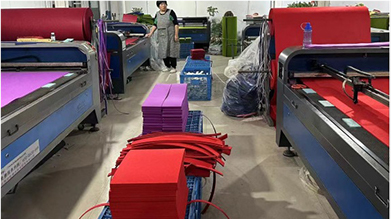
The constituent fibers of red craft felt dictate its properties. Polyester fibers contribute to tensile strength and resistance to stretching. Rayon provides softness and improved dyeability, lending to the vibrant red hue. Acrylic fibers offer wool-like characteristics, including warmth and resilience. Raw materials undergo a carding process, aligning the fibers into a web. This web is then subjected to needle punching – a mechanical process employing barbed needles to interlock the fibers, creating a cohesive fabric without the need for weaving or knitting. Density, typically ranging from 0.1 to 0.5 g/cm³, is controlled by the number of needle punches and the weight of the fiber web. Critical parameters include needle penetration depth (influencing fiber entanglement), needle density (affecting fabric uniformity), and web weight (determining thickness and overall density). Chemical compatibility is crucial; polyester offers good resistance to many solvents, while rayon is susceptible to degradation by strong acids and alkalis. Variations in fiber blend ratios directly impact properties such as moisture absorption and flammability. Colorfastness is achieved through the use of reactive dyes, requiring careful control of dye concentration, temperature, and fixation time to prevent bleeding or fading.
Performance & Engineering
The performance of red craft felt is intrinsically linked to its compressive strength and resilience. Under load, the fibers deform and redistribute stress, providing cushioning and sealing capabilities. Force analysis involves considerations of Poisson’s ratio (measuring lateral strain under uniaxial compression) and the stress-strain curve, characterizing the material's elastic and plastic behavior. Environmental resistance is a key concern. Prolonged exposure to ultraviolet (UV) radiation can cause fiber degradation, leading to embrittlement and color fading. Moisture absorption can alter dimensional stability and reduce compressive strength. Flammability is another critical factor, with standards like FMVSS 302 (Federal Motor Vehicle Safety Standard) dictating acceptable burn rates for interior applications. Compliance requirements vary by industry; for filtration applications, particle retention efficiency and pressure drop are key metrics. In gasketing, the material must exhibit sufficient creep resistance to maintain a seal over extended periods. The inherent porosity of felt requires consideration in applications where fluid permeability is undesirable; coatings or lamination with impermeable films may be necessary.
Technical Specifications
| Property | Unit | Typical Value (Range) | Test Method |
|---|---|---|---|
| Density | g/cm³ | 0.2 – 0.5 | ASTM D3801 |
| Tensile Strength (MD) | N/50mm | 5 – 15 | ASTM D4681 |
| Tensile Strength (CD) | N/50mm | 3 – 10 | ASTM D4681 |
| Elongation at Break (MD) | % | 50 – 150 | ASTM D4681 |
| Elongation at Break (CD) | % | 80 – 200 | ASTM D4681 |
| Thickness | mm | 1 – 5 | ASTM D1777 |
Failure Mode & Maintenance
Red craft felt is susceptible to several failure modes. Fatigue cracking can occur under cyclic loading, particularly in applications involving repeated compression and release. This is exacerbated by fiber degradation and the presence of stress concentrators (e.g., defects or inclusions). Delamination, the separation of layers within the felt structure, can result from insufficient fiber entanglement or exposure to solvents. Oxidation, particularly in acrylic-rich felts, leads to embrittlement and loss of flexibility. UV degradation, as mentioned previously, causes fading and weakens the fibers. Moisture absorption can promote microbial growth, leading to material decomposition. Maintenance primarily focuses on preventative measures. Regular inspection for signs of wear, cracking, or delamination is crucial. Avoid exposure to harsh chemicals and prolonged UV radiation. Storage should be in a cool, dry, and well-ventilated area. If contamination occurs, gentle cleaning with mild detergent and water may be possible, but avoid aggressive scrubbing or solvent-based cleaners. Replacement is typically the most cost-effective solution once significant degradation is observed.
Industry FAQ
Q: What is the expected lifespan of red craft felt in a typical gasketing application?
A: The lifespan is highly dependent on the operating temperature, pressure, and the chemical compatibility of the gasketed fluids. Generally, a polyester-based red craft felt gasket can maintain adequate sealing performance for 6-12 months in a mild environment (ambient temperature, low pressure, non-aggressive fluids). More aggressive conditions will significantly reduce this timeframe.
Q: How does the fiber blend affect the flammability of red craft felt?
A: Acrylic fibers are inherently more flammable than polyester or rayon. A higher acrylic content will result in a lower ignition temperature and faster burn rate. Flame retardant treatments can be applied, but these may compromise other performance characteristics.
Q: Can red craft felt be used as a filter medium for particulate matter?
A: Yes, but its filtration efficiency is limited by its inherent porosity. It's suitable for coarse filtration applications where high efficiency isn't critical. Pre-treating the felt with a binder or coating can improve its filtration performance, but also increases cost.
Q: What is the impact of humidity on the dimensional stability of red craft felt?
A: Red craft felt is hygroscopic, meaning it absorbs moisture from the air. This absorption leads to swelling and dimensional changes. Rayon content exacerbates this effect. Dimensional changes can be minimized by using a polyester-rich felt or by applying a waterproof coating.
Q: What are the advantages of needle punching over other non-woven fabric manufacturing processes for red craft felt?
A: Needle punching is a relatively low-cost and efficient process that doesn’t require binders or adhesives. It produces a fabric with good loft and compressibility, making it suitable for a wide range of applications. Other processes, like thermal bonding or chemical bonding, can alter the felt's properties and potentially introduce undesirable chemicals.
Conclusion
Red craft felt, despite its seemingly simple construction, possesses a complex interplay of material properties and manufacturing parameters that influence its performance. Its cost-effectiveness, conformability, and versatility make it a valuable material across a spectrum of industrial applications. However, understanding its limitations – particularly regarding environmental resistance, flammability, and dimensional stability – is crucial for ensuring long-term reliability and optimal performance.
Future developments may focus on incorporating sustainable fiber sources, enhancing flame retardancy through novel coatings, and improving dimensional stability through advanced fiber entanglement techniques. Continued innovation in needle punching technology will also contribute to optimizing the cost-performance ratio of this widely used material.


 English
  Afrikaans
  Albanian
  Amharic
  Arabic
  Armenian
  Azerbaijani
  Basque
  Belarusian
  Bengali
  Bosnian
  Bulgarian
  Catalan
  Cebuano
  Corsican
  Croatian
  Czech
Czech  Danish
  Dutch
Dutch  Esperanto
  Estonian
  Finnish
  French
  Frisian
  Galician
  Georgian
  German
  Greek
Greek  Gujarati
  Haitian Creole
  Hausa
Hausa  Hebrew
  Hindi
Hindi  Miao
Miao  Hungarian
  Icelandic
  Igbo
Igbo  Indonesian
  Irish
Irish  Italian
  Japanese
  Javanese
  Kazakh
  Khmer
Khmer  Rwandese
  Korean
  Kurdish
  Kyrgyz
  Lao
Lao  Latin
Latin  Latvian
  Lithuanian
  Luxembourgish
  Macedonian
  Malgashi
  Malay
Malay  Malayalam
  Maltese
  Maori
Maori  Marathi
  Mongolian
  Myanmar
  Nepali
  Norwegian
  Norwegian
  Occitan
  Pashto
  Persian
  Polish
  Portuguese
  Romanian
  Russian
  Samoan
  Scottish Gaelic
  Serbian
  Sesotho
  Shona
Shona  Sindhi
  Sinhala
  Slovak
  Slovenian
  Somali
  Spanish
  Sundanese
  Swahili
  Swedish
  Tajik
Tajik  Tamil
Tamil  Tatar
Tatar  Telugu
  Thai
Thai  Turkish
  Turkmen
  Ukrainian
  Urdu
Urdu  Uighur
  Uzbek
Uzbek  Vietnamese
  Welsh
Welsh  Bantu
Bantu  Yiddish
  Yoruba
  Zulu
Zulu